ArtVals visits Ron Mueck: Gods, Giants and the Shoreline of Ourselves
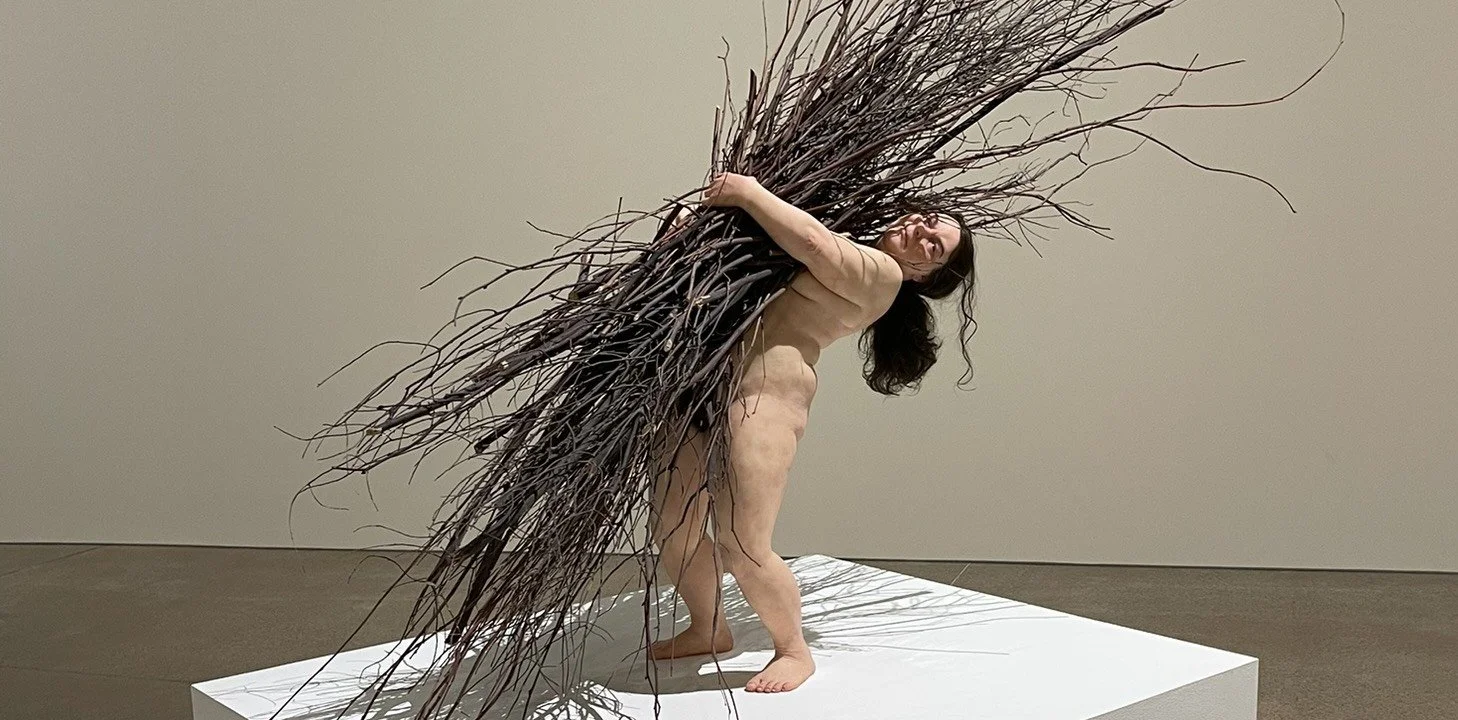
Ron Mueck Woman with Sticks 2009
Before we monumentalised the ordinary, we monumentalised the divine.
In ancient Egypt the human body was constructed for eternity, carved frontal and immovable so that kings and gods could transcend decay through stillness. In ancient Greece the body shifted from symbol to system, proportion codified into harmony, symmetry moralised, divinity rendered in perfected anatomy so that to look upon sculpture was to look upon order itself. The human form was never merely flesh. It was theology, politics, cosmology.
Across centuries we returned to it again and again, refining, enlarging, dramatising. Renaissance marble charged it with tension. Modernism fractured it under existential pressure. But beneath all stylistic shifts sits something more enduring and more revealing.
We are obsessed with ourselves.
Not in the shallow sense of vanity, but in the deeper sense that the human body is the only structure we permanently inhabit. It is our measure of scale, our calibration of space, our index of time. We wake inside it, age inside it, suffer and desire inside it. And yet in daily life we barely register it. We pass ageing bodies, resting bodies, bodies in swimmers at the beach, and they dissolve into background.
Until an artist intervenes.
At the Art Gallery of New South Wales, Ron Mueck removes myth and leaves us with something far more destabilising than gods.
He gives us ourselves.
Intimacy and Scale
Before the giants at the beach and the compressed domestic standoff, there is another recalibration.
Woman with Sticks (2009) stands on a plinth, small in scale, almost doll-like at first encounter. You expect monumentality. Instead, you are drawn downward.
She gathers a bundle of sticks tightly against her chest. The branches press into her arms. Her grip is firm. Her weight shifts subtly backwards, her torso leaning away to counterbalance the load she carries. There is nothing theatrical about the gesture. It is labour. Practical. Repetitive. Necessary.
Because of the reduction in scale, you do not stand before her in awe. You lean toward her. Your body dominates the space physically, yet the concentration in her posture holds you in place. The slight backward tilt, the tension in her forearms, the compression of flesh against wood all become legible in a way they might not be at life size.
The smallness intensifies attention.
Again, the hyperreal surface never collapses into illusion. The sticks are constructed. The skin is built. The textures carry the quiet evidence of process. She is not a scanned replica. She is a shaped encounter.
Scale here is not spectacle. It is psychological positioning.
The Island and the Sea
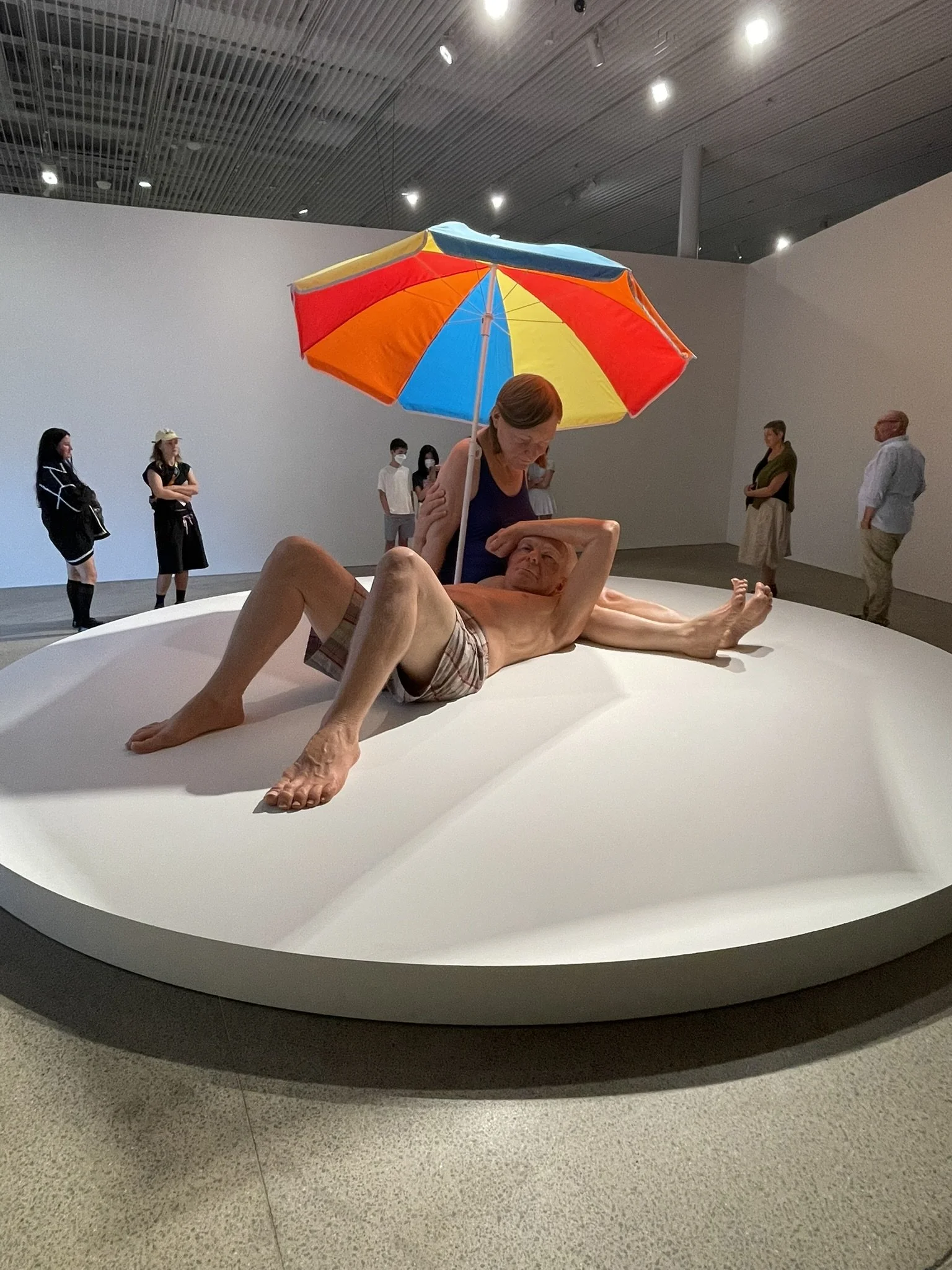
Couple Under an Umbrella (2013) is, on the surface, an image so familiar to Australians it barely registers as image at all. Two older figures seated beneath a striped beach umbrella. Practical swimmers. Pale skin softened by time. A stretch of sand. The lull between swims.
We are coastal dwellers. The beach is not allegory. It is routine. It is memory layered over decades.
Yet here the couple are monumental.
They sit like giants. The man’s torso carries the gentle weight of age. The woman’s posture folds slightly inward. Their shoulders hover near one another but do not fully collapse into embrace. Their gazes drift outward, not at us, not at each other, but somewhere beyond. Shared proximity, separate interiors.
Scale transforms the scene from casual to commanding. Ageing skin becomes landscape. The folds at the waist become contour. The stillness acquires gravity.
The sculpture rests on a circular plinth, and almost immediately the audience begins to move. No one stands fixed. We circle instinctively. Slowly. Adjusting vantage point. Leaning in to read expression. Stepping back to take in proportion.
The plinth reads like an island of sand rising from the white floor of the gallery.
The couple remain anchored beneath their umbrella, self-contained, while we move around them like water. At times the motion feels tidal, gentle and observant. At others it carries something sharper, almost predatory, as though we are sea life tracing the perimeter of a shoreline. Sharks circling intimacy. Testing the boundary between observation and intrusion.
On a real beach these two would dissolve into the crowd within seconds. Here they command the currents of our attention.
The spectacle is not what they are doing.
It is what we are doing.
Compression and Confrontation
If Couple Under an Umbrella expands the ordinary to monumental scale, Chicken/Man (2019) compresses it.
An older man sits at a table in his jocks. His spine curves slightly forward. The skin at his waist relaxes naturally. Nothing is idealised. Nothing is disguised. Across from him stands a full-feathered chicken, upright on the tabletop, meeting his gaze.
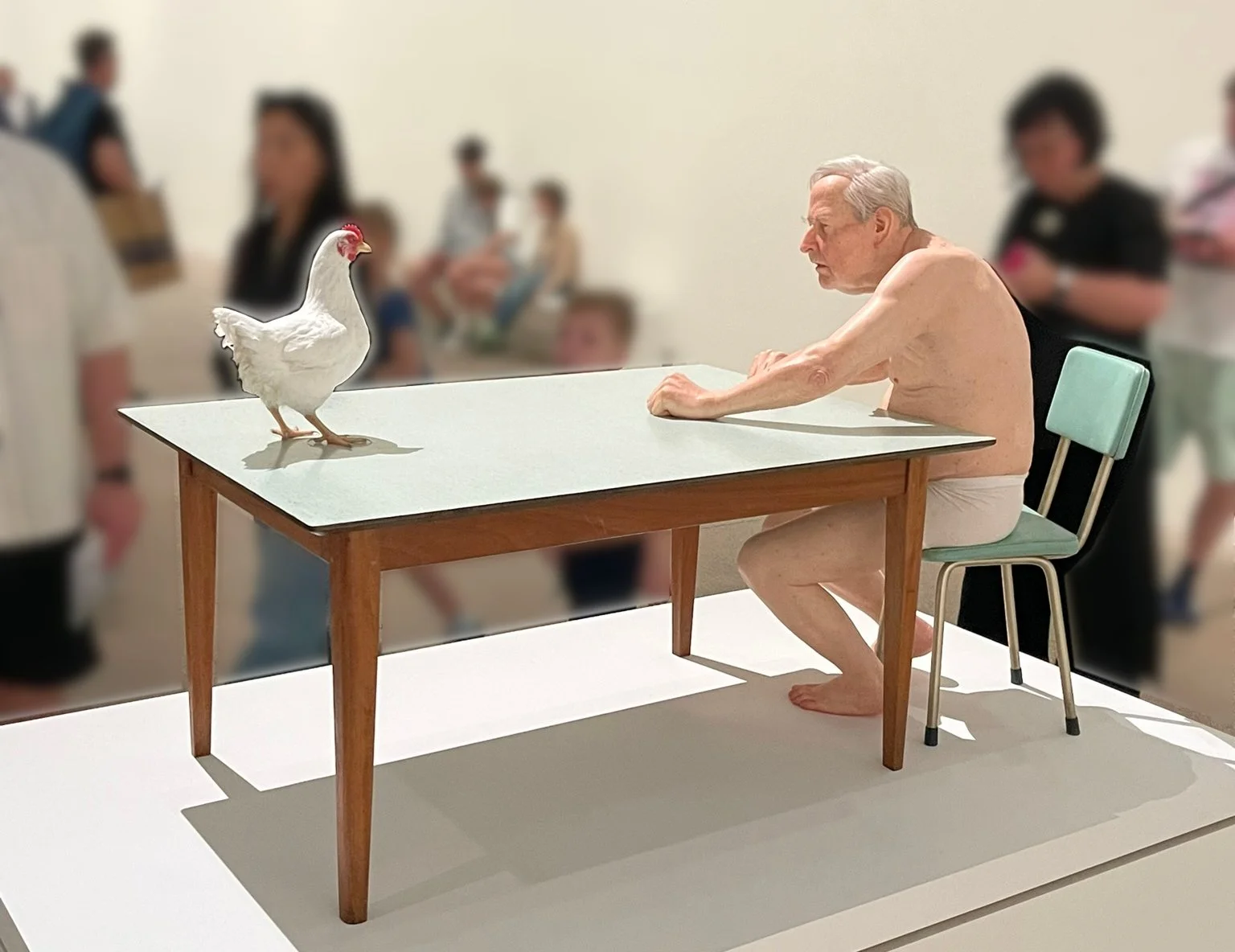
The entire scene is reduced, roughly forty percent of life size. You bend toward it without thinking. The compression intensifies the psychological space between them.
Then the gaze locks in.
The man studies the bird. The bird faces him directly. It is a stand-off without aggression, an exchange without dialogue. At first the pairing reads as absurd. The longer you stand there, the more the absurdity drains away and something else emerges.
Presence.
Two bodies. Two living forms occupying a narrow strip of tension.
Hierarchy blurs. The human does not dominate. The animal does not retreat. The domestic setting becomes theatrical simply through isolation. A table becomes stage. A kitchen moment becomes philosophical inquiry.
And yet for all the astonishing fidelity of feather and flesh, the work never collapses into illusion. The feathers are constructed. The skin is built. The fabric of the jocks carries weight because it has been shaped with deliberation. There is always the quiet hum of authorship. These are not carbon copies. They are composed encounters.
That distinction matters. The realism invites recognition. The evidence of the artist’s hand keeps the work anchored in art rather than simulation.
The Shock of Displacement
What Mueck understands with precision is that the human body becomes most unsettling when it is displaced.
We see bodies every day. At supermarkets. On trains. On beaches. Ageing, awkward, resting, thinking bodies. They barely interrupt our field of vision.
Place that same body on a plinth. Alter its scale. Remove narrative noise. Suspend it in stillness.
Suddenly we are transfixed.
Scale ruptures complacency. Enlarge the body and we feel dwarfed by our own humanity. Reduce it and we lean in, aware of our dominance as viewers. Either way, we are destabilised.
The human form has travelled from divine symbol to heroic ideal to existential fragment. In Mueck’s hands it becomes something both simpler and more confronting.
It becomes presence.
Not allegory. Not metaphor.
Presence.
And presence, once framed, becomes spectacle.
ArtVals Reflection
This exhibition does not overwhelm through quantity. It lingers through encounter. It reminds us that the most radical subject in art has never been the extraordinary but the familiar.
From Egyptian permanence to Greek perfection to giants at the beach beneath striped umbrellas, the body has always been our mirror. What shifts is how directly we are made to face it.
In Mueck’s work we circle ourselves.
We study ageing skin as if it were new terrain. We lean toward domestic stillness as if decoding ritual. We orbit intimacy as though tracing the edge of an island.
The figures remain still.
We are the ones in motion.
And perhaps that is the most revealing element of all.
Now on show at the Art Gallery of New South Wales until 12 April 2026.