Margaret Olley: A World of Her Own
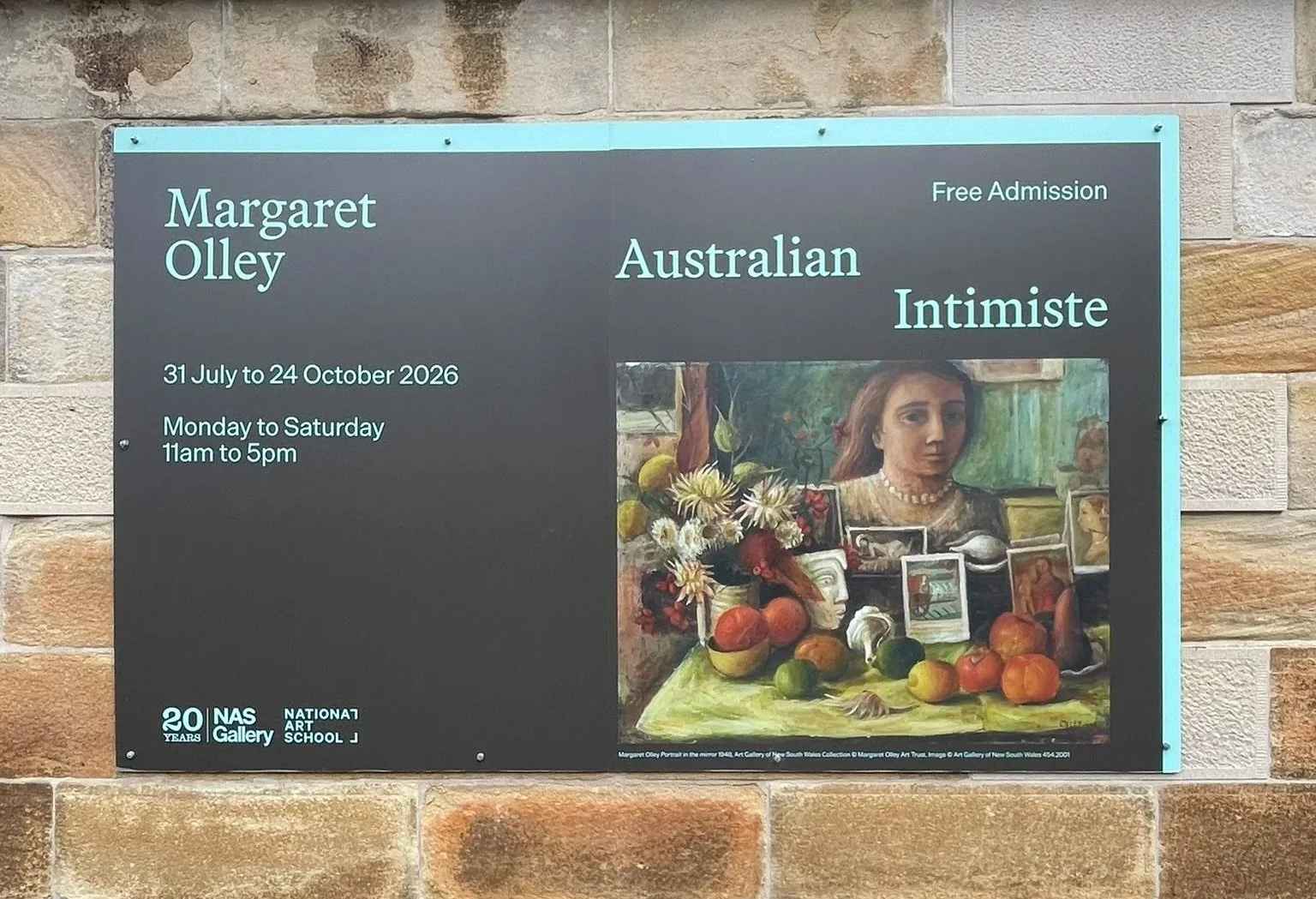
There is something remarkable about standing in front of a Margaret Olley painting, particularly when so many of them are brought together and you are given the opportunity to move between different periods of her life and see the development of a visual language that became unmistakably her own.
This is perhaps the fourth major exhibition of Olley’s work that I have seen, and the paintings remain as beautiful and engaging as ever. Each encounter, however, seems to reveal something different. This time, at Margaret Olley: Australian Intimiste at the National Art School, I found myself looking less at what Olley painted and more closely at how she painted it, as well as at the extraordinary environments she created and inhabited in order to paint.
The exhibition’s title, Australian Intimiste, is particularly apt. Intimisme emerged in France around artists such as Pierre Bonnard and Édouard Vuillard, who turned their attention towards the intimate world immediately around them: domestic interiors, familiar rooms and the everyday objects of private life. Olley was not an Intimiste in the historical sense; she belonged to a different generation and place. Yet there is an obvious affinity with the French Intimistes in the way she made the domestic interior a world worthy of sustained observation. The title also seems particularly appropriate because these paintings allow us into something deeply personal: the rooms she inhabited, the objects she collected and ultimately the way she saw.
Her interiors were not simply subjects. They became her domain, and over the course of her life the places in which she lived and worked became inseparable from the paintings she produced.
Long before Duxford Street became synonymous with Olley, there was Farndon, her family’s home in Brisbane. It was a place she had known since childhood and one to which she repeatedly returned, both physically and through her paintings. The house, its rooms, garden and accumulated objects became an important source of subject matter, establishing early in her career the relationship between home, memory and painting that would become increasingly important to her work.

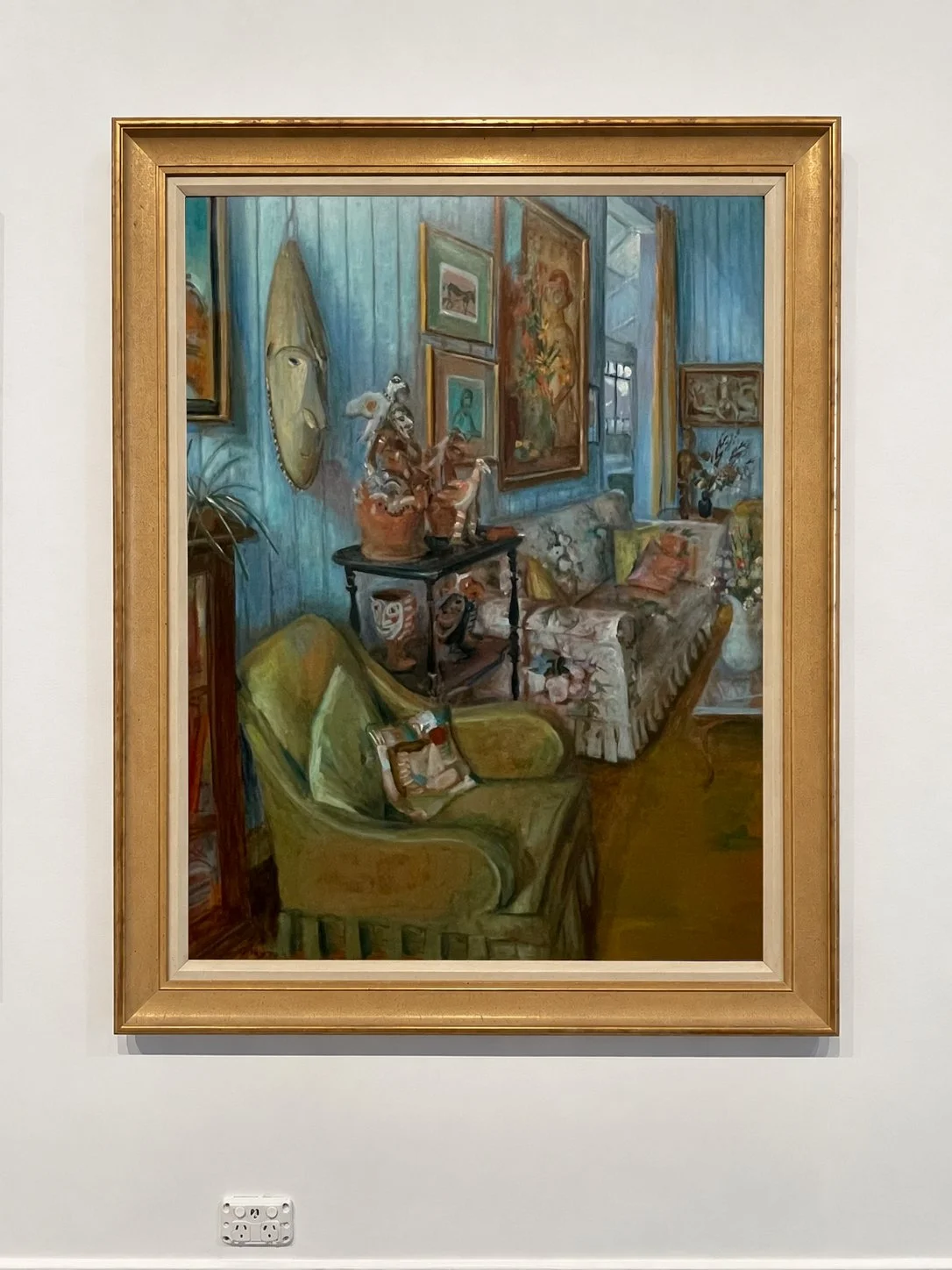
Olley produced twelve large interiors inspired by Farndon for her 1970 exhibition at Johnstone Gallery. Interior III, 1970, included in the current exhibition, gives us an extraordinary glimpse into this earlier domestic world. Furniture, pictures, textiles and collected objects fill the room, while the view continues through a doorway into another space beyond. Looking at it now, it is difficult not to see the beginnings of the interior world that would later become so closely associated with Olley at Duxford Street.
Olley, however, was never completely anchored to one place. At different times she moved between Brisbane, Newcastle and Sydney, painted while travelling and worked in the homes of friends. During the 1970s she described herself as “living in a basket”, carrying her paints, brushes and belongings between the different places in which she lived and worked.
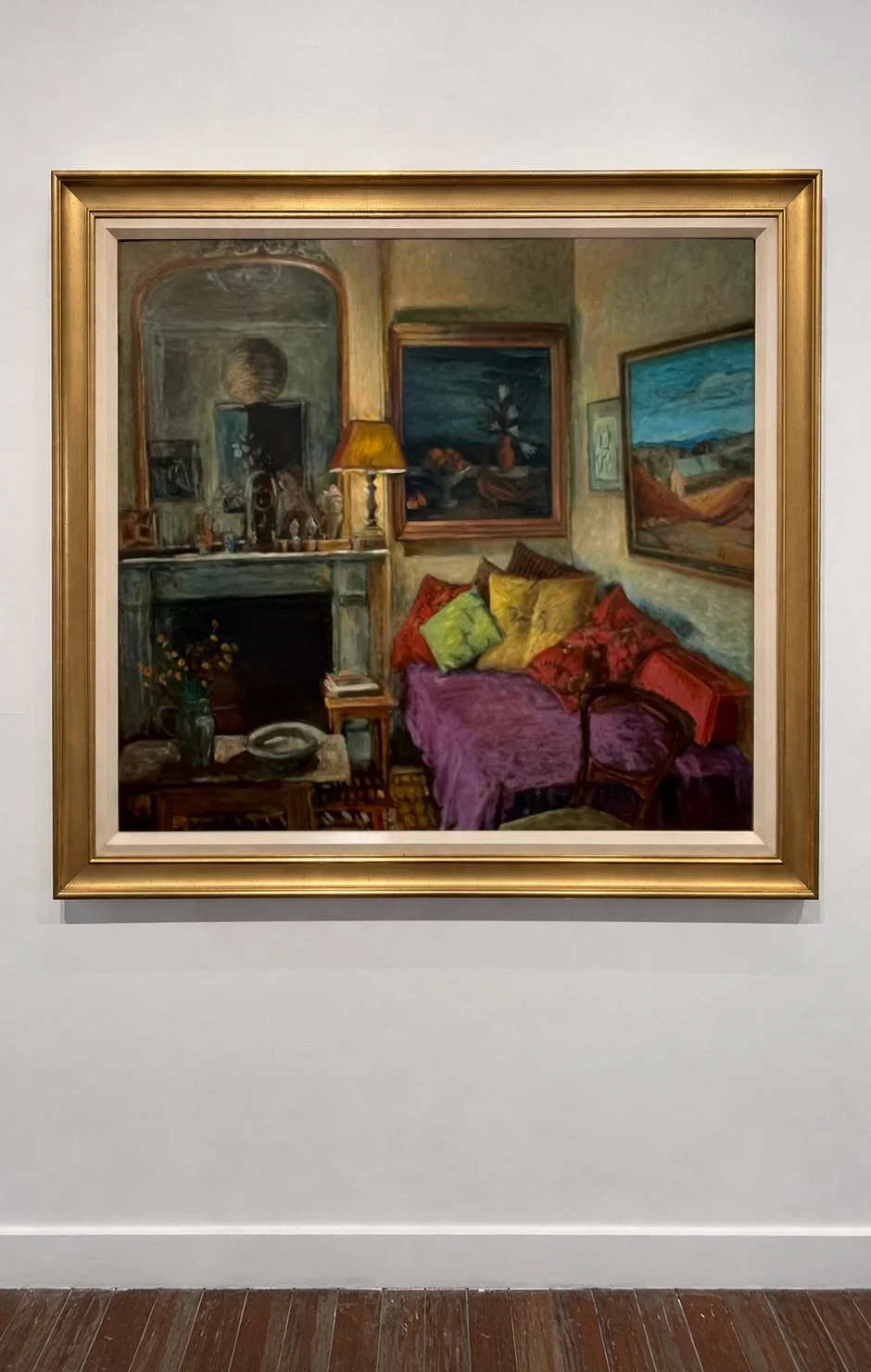
Night interior, 1972, oil on canvas. Private Collection, courtesy Philip Bacon Galleries. Painted in the Paddington home of Olley’s close friend David Strachan, the room is transformed by the warm glow of artificial light. Pictures, furniture and accumulated objects emerge from the surrounding half-light, demonstrating how changing light could alter the character and atmosphere of a familiar interior.
One of the most significant of these places belonged not to Olley, but to her close friend and fellow artist David Strachan. Following Strachan’s sudden death in 1970, Olley received permission from his family to continue painting in his Paddington home, a place she already knew intimately and where she had previously worked. The interiors subsequently became the basis of her 1972 Homage exhibition at Johnstone Gallery, and she continued using the house as a studio during the 1970s.
Strachan’s home was an intensely personal environment, filled with antique wooden furniture, rugs, copper pots and pans, paintings and objects gathered during his travels. In Night interior, 1972, the room is transformed by artificial light, with the glow of a table lamp illuminating the pictures, furniture and accumulated objects around it. It is a wonderfully intimate painting and demonstrates how completely the character of an interior could change for Olley according to the light in which she encountered it.
Then there was Duxford Street, the place that would eventually become almost inseparable from our understanding of Margaret Olley.
In 1964, Olley purchased a property in Duxford Street, Paddington, which included a former hat factory. She gradually renovated and transformed the property over the following decades, eventually establishing the former factory as the home and studio that became synonymous with her later work. There is something wonderfully creative about the transformation itself because Olley did not simply find an interior to paint; over time, she effectively built one.
The former factory gradually became a world of her own making, filled with flowers, fruit, ceramics, postcards, souvenirs, books, rugs, textiles, furniture, paintings and reproductions of artists she admired. Objects were collected, moved, rearranged and rediscovered, allowing a table to become a still life, a doorway to frame another composition, or a screen to divide a room while simultaneously becoming part of a painting.
Her home became studio, subject and prop, and the Duxford Street paintings therefore record far more than the appearance of the rooms in which Olley lived. They record an environment she spent decades creating, arranging, observing and ultimately translating into paint.
Painting became her voice
Olley’s commitment to painting was extraordinary, and throughout her career she returned to the same rooms and sometimes the same objects again and again without allowing repetition to result in sameness. A change in the time of day, the position of an object, a vase of different flowers or simply the way light entered a room could provide the beginning of another painting.
Still life gave her an extraordinary degree of freedom. An arrangement did not disappear with changing weather, nor did a sitter eventually grow tired of posing. Objects could remain where they were, be moved, replaced or rediscovered months or even years later, allowing Olley to return to an arrangement under completely different conditions of light. Christine France has observed that Olley would sometimes leave an arrangement in place for years before returning to it in a different light or surrounded by different objects.
There is something in this that makes me think of Claude Monet returning repeatedly to Rouen Cathedral. The cathedral remained essentially the same, but the light, atmosphere and the artist’s perception of it changed. Olley’s subject may have been a room rather than a cathedral façade, but there is a similar understanding that a familiar subject is never truly exhausted when the artist continues to look at it closely.
Her Yellow Room is perhaps the clearest example of this approach because Olley continually reconfigured the space, moving and replacing objects and discovering new compositions within surroundings she had painted many times before. Familiarity did not exhaust the subject. Rather, it allowed her to look more closely, and through decades of sustained observation, the way Olley painted gradually became her voice.
This is much more apparent in person than it is in reproduction. From several metres away, an Olley painting can appear beautifully resolved, with flowers sitting in a vase, lemons catching the light, ceramics occupying a table and one room opening into another. Yet as you move closer, that certainty begins to dissolve and the individual brushstrokes become increasingly apparent.
A flower might be constructed from only a few deft marks, while a reflection on a ceramic vessel can be conveyed with a single stroke of paint. The fold of a cloth or the edge of a table is suggested rather than meticulously described, leaving enough information for the eye to complete what Olley has begun.
Cornflowers and red lacquer compote, 2010–11, provides a wonderful example. From a normal viewing distance the flowers, ceramics and richly patterned textiles appear immediately legible, yet close up their forms begin to dissolve into individual strokes and passages of colour. The cornflowers in particular are constructed from remarkably economical marks, while the brilliant red compote is built from broad strokes that describe light, form and reflection without attempting to reproduce the object precisely. Seen at this distance, we are no longer simply looking at flowers and objects. We are looking at Olley painting.

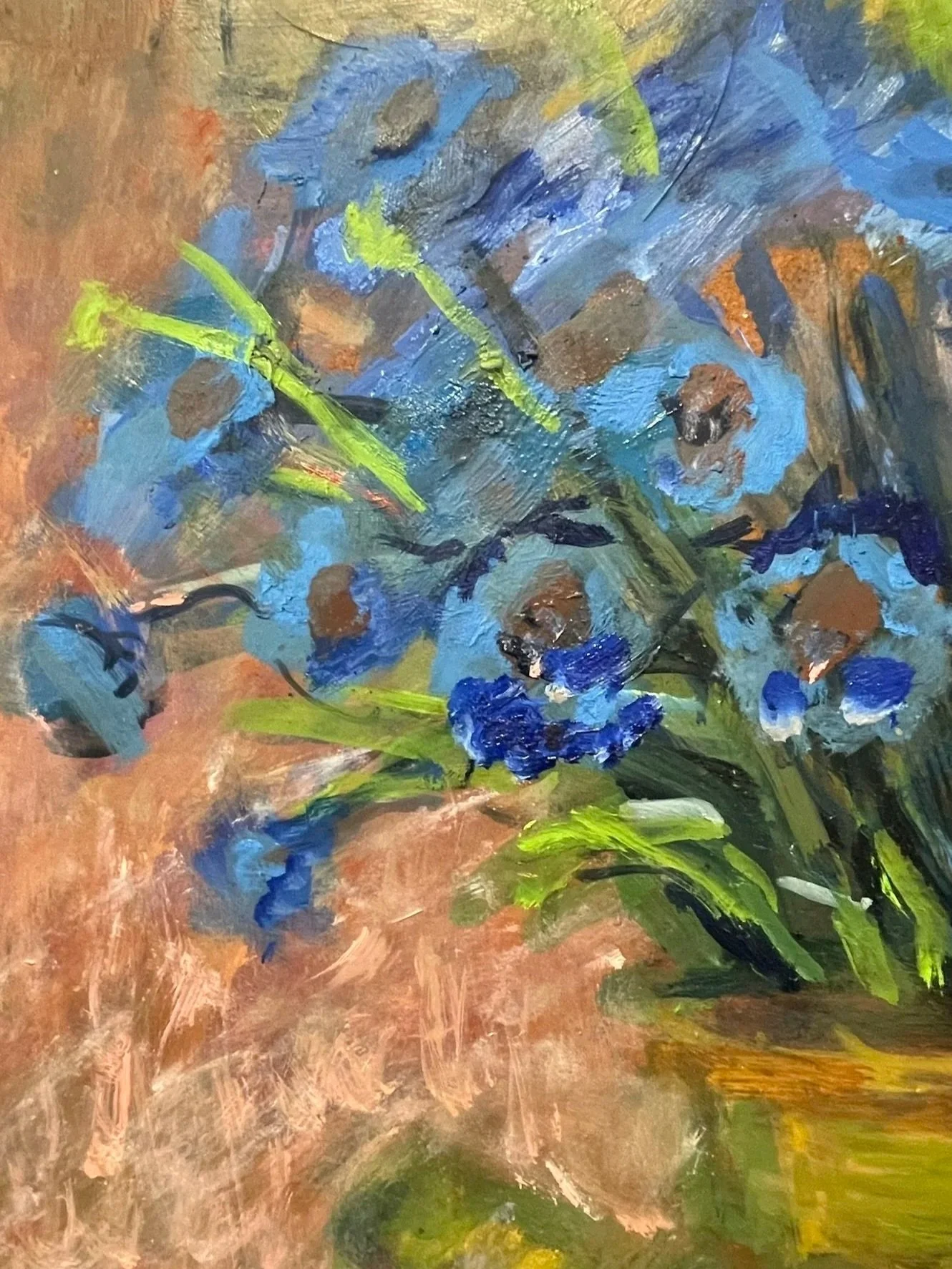
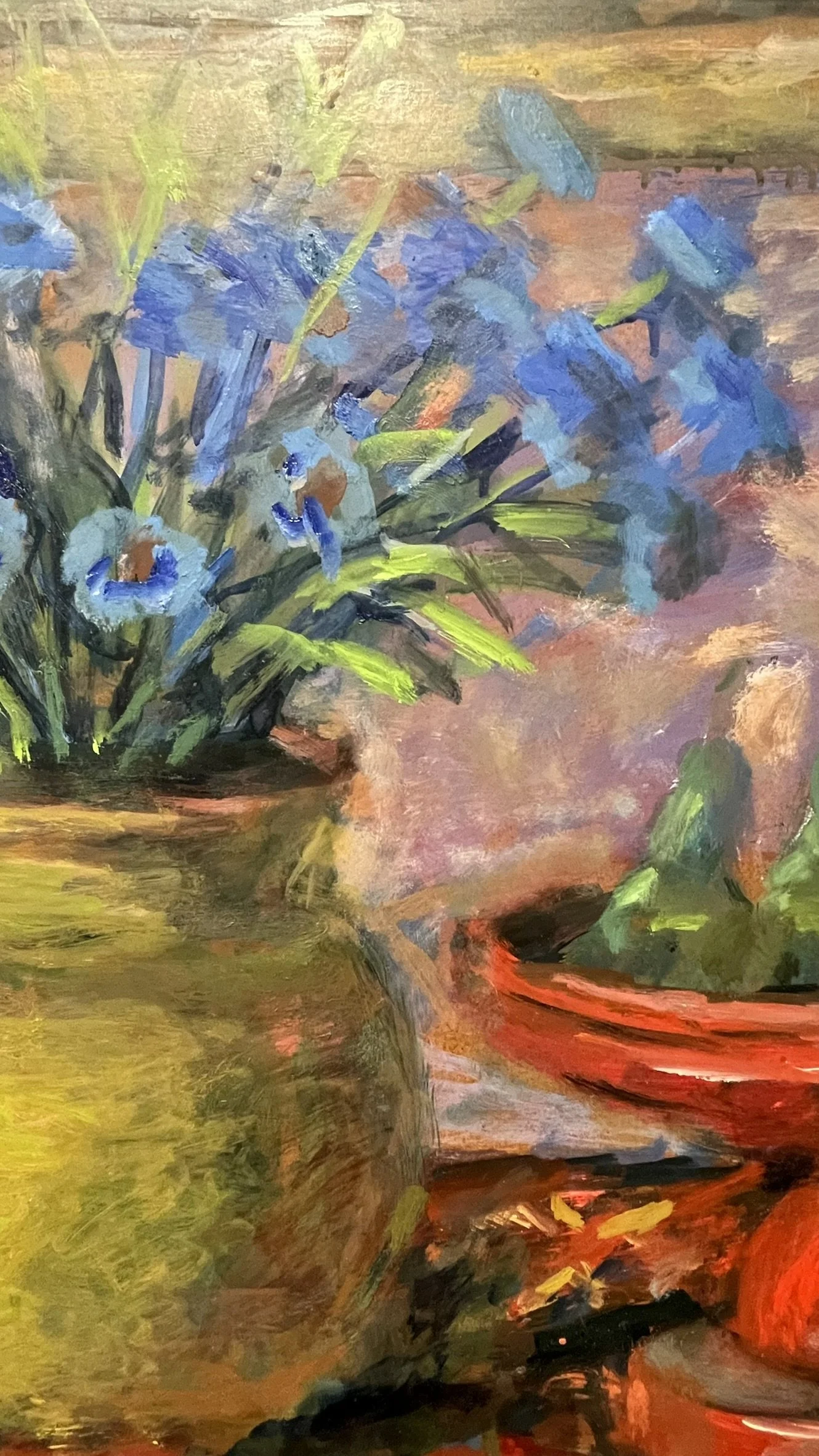
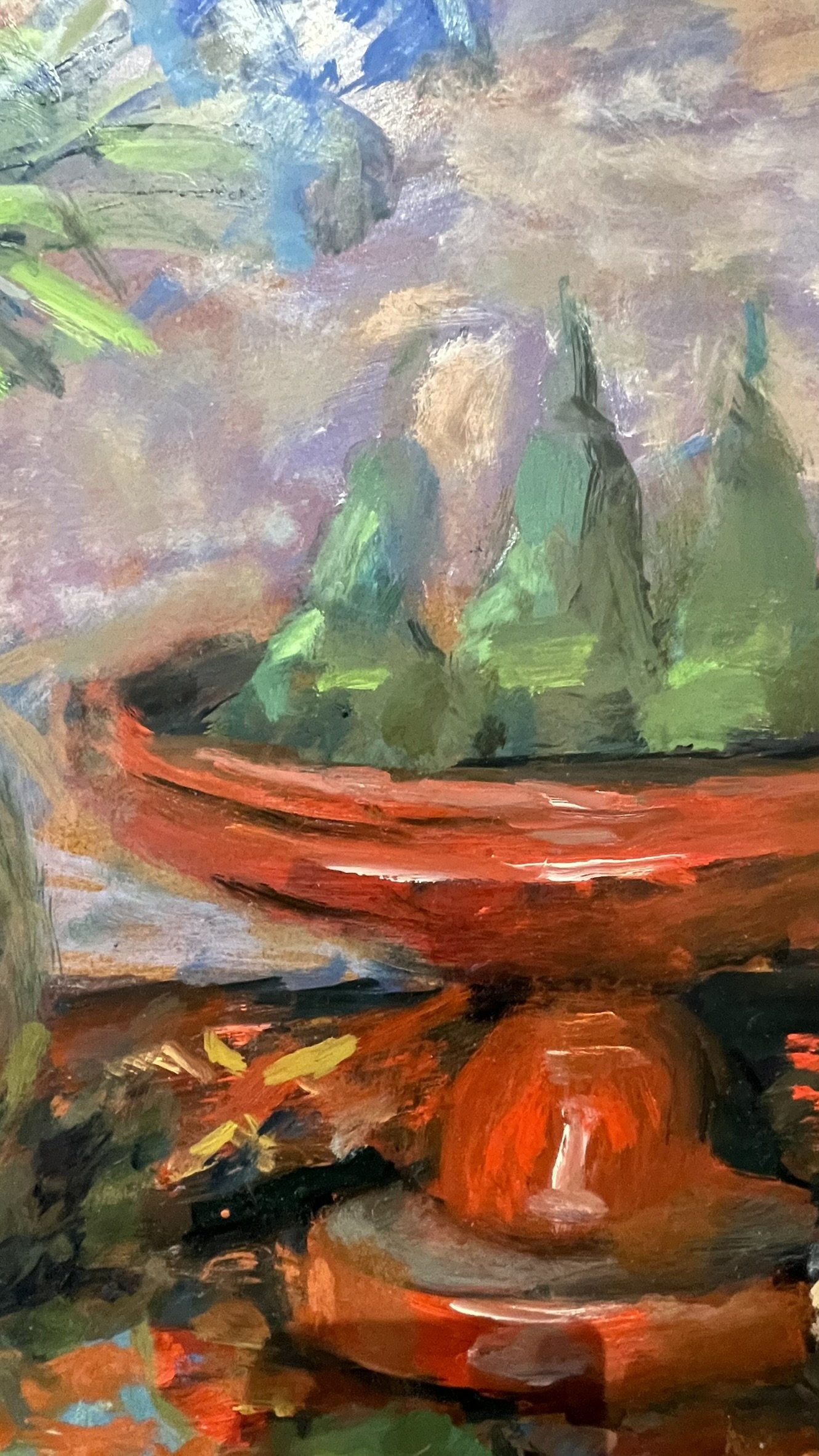
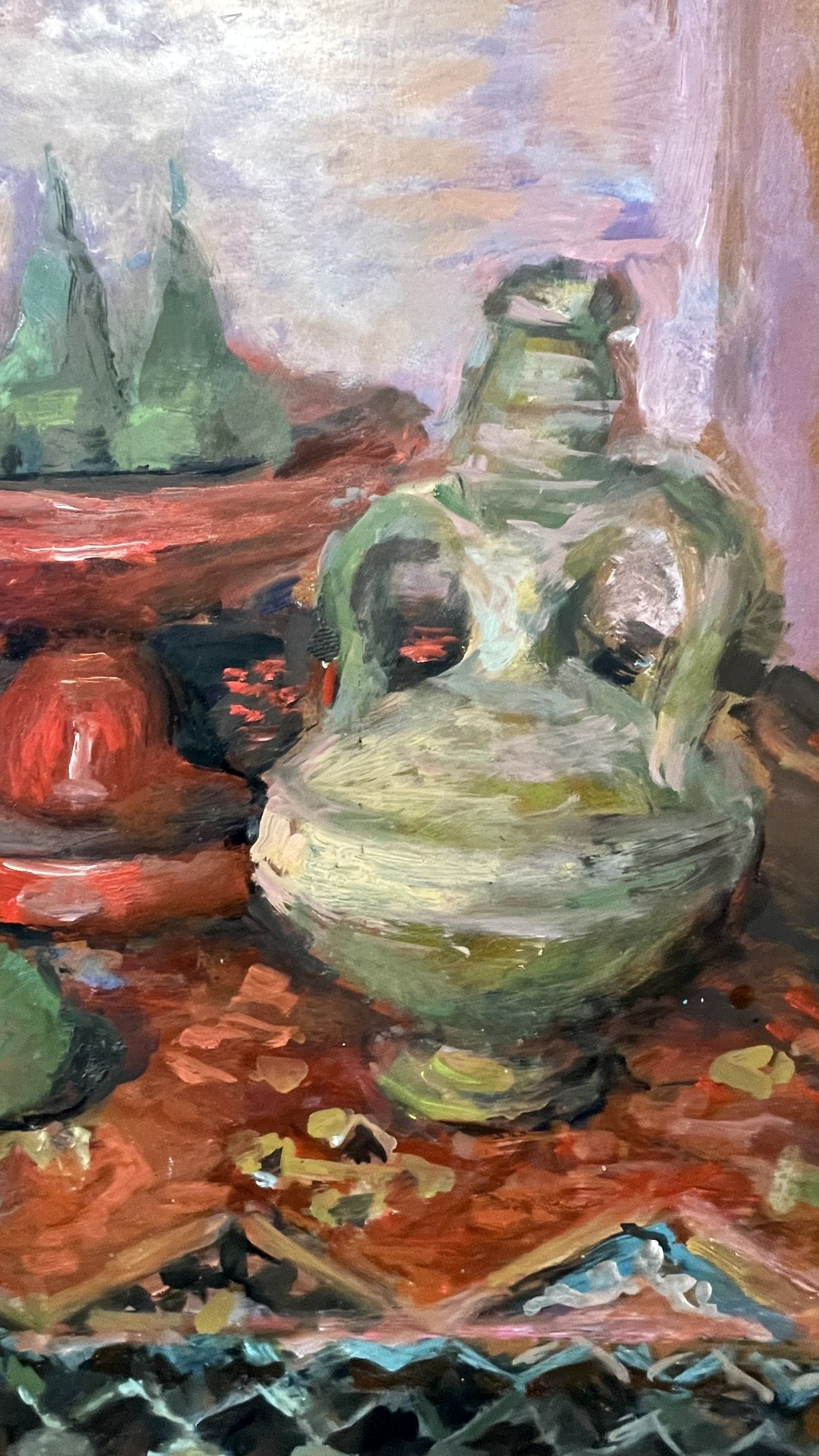
Olley was not attempting to compete with photography or create a photorealistic record of the objects before her. In fact, part of what makes an Olley more compelling than a photograph is the imperfection of the human hand. A line might wander, perspective can shift, an object may be simplified and a flower reduced to only a handful of brushstrokes. These apparent imperfections are not shortcomings. They are evidence of an artist looking, deciding and responding to what she sees.
Stand close enough and the illusion begins to fall apart. Step backwards and those imperfect marks somehow resolve themselves into flowers, fruit, furniture and light. A photograph can show us what was there. The painting shows us how Olley saw it.
There is a delicacy to the paintings, but also an immediacy that preserves the movement of the brush and the decisions she made as she worked.
The surface
One thing I particularly noticed in this exhibition was just how many of the paintings were executed on board, and the firm surface seems particularly suited to Olley’s touch. Unlike the slight give of canvas, board provides resistance beneath the brush, creating a directness in the way the paint is applied and allowing individual marks to remain clearly visible.
Olley is documented as favouring boards prepared with a matt ochre ground, establishing her composition before developing the painting in oils. Seeing so many of these works together made me much more conscious of the relationship between the support, the paint and the finished surface.
I was also struck by how relatively matt many of the paintings appeared. They do not have the uniformly glossy surface sometimes associated with oil painting, yet they are certainly not visually flat because, as you move in front of them, individual passages catch the light and produce a subtle shimmer while other areas remain soft and matt.
It is tempting to wonder how much of this resulted from Olley’s particular mixtures of paint, oils and solvents, although without a documented formula it would be speculative to say exactly how these surfaces were achieved. What remains in front of us is a remarkably varied painted surface in which the material qualities of the paint become an important part of the experience of looking at the work.
At close range, the physicality of Olley’s painting becomes increasingly apparent as some passages remain lean and matt while others catch the light, with the individual brushstrokes clearly visible across the surface. As you move backwards, those separate marks gradually come together and the flowers, objects and rooms re-form before your eyes, which is something reproduction simply cannot convey and one of the reasons these paintings need to be experienced in person.
Three works
The Yellow Room Triptych, 2007
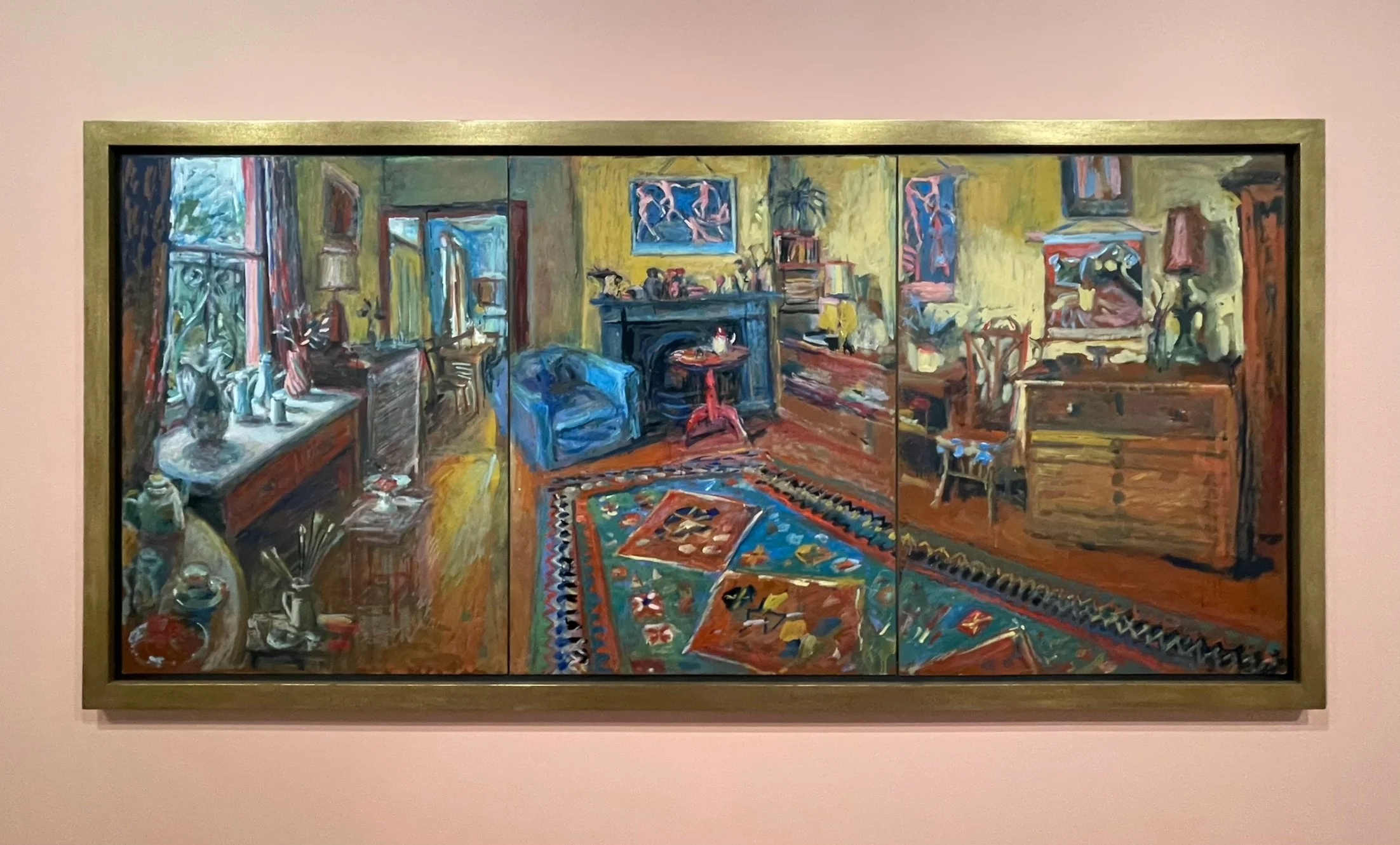
The Yellow Room Triptych, 2007, oil on Masonite board. New England Regional Art Museum Collection. Olley’s celebrated Yellow Room opens across three panels, crowded with the furniture, flowers, textiles, paintings and collected objects that formed the visual world of her Duxford Street home. Among them is a reproduction of Henri Matisse’s Dance, a reminder of the artists Olley admired and absorbed into her own domestic environment. The triptych demonstrates how completely her home had become both subject and studio, with one room opening into another and everyday objects transformed through colour, light and repeated observation.
If one painting encapsulates Olley’s interior world, it is The Yellow Room Triptych. At approximately 182 × 366 cm across its three panels, it is an enormous work, approaching the scale of the room it depicts. The triptych format expands our field of vision, giving the painting an almost panoramic quality and allowing us to feel as though we are entering the room rather than simply looking into it.
There is also a wonderful distortion to the space. Perspective shifts across the three panels, furniture seems to tilt or project towards us and the rooms do not submit entirely to a single, mathematically consistent viewpoint. It reminds me somewhat of Van Gogh’s The Night Café, 1888, where the exaggerated perspective around the red billiard table makes us experience the room rather than simply observe it. Olley’s distortions are gentler, but they similarly remind us that this is not an architectural record of Duxford Street. It is a painted experience of being inside it.
Pictures, furniture, textiles, flowers and collected objects occupy the interior, while openings within the composition extend our view into adjoining spaces and beyond. The room is unmistakably domestic, but it is also constructed, because Olley continually moved and rearranged objects in search of relationships between colour, form and light, effectively creating the subject before translating it into paint.
In this sense, Duxford Street became almost a permanent stage for her painting. The rooms provided the setting, while the furniture, flowers, ceramics, textiles and collected objects became the props she could move, remove and rearrange as the composition demanded. A doorway could frame another room, a table could become the setting for a still life, or an object moved only slightly could alter the balance of an entire composition. The remarkable thing is that this stage was also her home, so the boundary between the environment in which Olley lived and the one she constructed for painting became increasingly difficult to separate.
The work demonstrates something fundamental about her practice, which is that she did not need to search endlessly for new subjects because she continued to discover new possibilities in the world immediately around her. Like Monet returning repeatedly to Rouen Cathedral, Olley could return to the same familiar surroundings because the light changed, the arrangement changed and, perhaps most importantly, she looked again.
Chinese screen and yellow room, 1996

Chinese screen and yellow room, 1996, oil on hardboard. Art Gallery of New South Wales Collection. Olley’s magnificent black-and-gold Chinese folding screen became a recurring presence in her Duxford Street interiors. Here it operates as both object and compositional device, its flattened decorative surface dividing the room while creating a richly patterned counterpoint to the space beyond. The screen was one of many Asian objects Olley collected and incorporated into the visual world of her paintings.
The magnificent black-and-gold Chinese folding screen is one of the recurring characters in Olley’s world, appearing in several paintings over many years and becoming part of the visual vocabulary through which we recognise her interiors.
In Chinese screen and yellow room, the screen functions simultaneously as an object, a pattern, a backdrop and part of the structure through which Olley organises the interior. At times it seems almost architectural, dividing the space while also providing a richly decorative surface against which other objects, colours and patterns can operate.
There is also an interesting art-historical context to the presence of Asian objects within modern Western painting. The Impressionists and Post-Impressionists had been fascinated by Japanese prints, screens and decorative objects, absorbing their flattened space, pattern and unusual approaches to composition. Olley belonged to a much later generation and her screen is Chinese rather than Japanese, but there is an intriguing visual echo in the way its flattened decorative surface interrupts conventional perspective while simultaneously becoming part of the space she is describing.
The screen also tells us something about the importance of collecting to Olley because her possessions were never simply decoration. Ceramics, textiles, furniture, postcards, reproductions, souvenirs and objects gathered over decades provided an ever-changing vocabulary from which she could construct paintings, with some objects carrying memories while others created relationships between colours, patterns and forms or simply caught the light in a way that interested her.
There are also quiet acts of homage throughout these interiors, with Cézanne, Manet, Bonnard, Matisse and other artists she admired entering Olley’s world through postcards, reproductions and references that sit comfortably alongside flowers, fruit, ceramics and the accumulated objects of everyday life. Her home was therefore much more than somewhere she happened to paint. Like the stage of Duxford Street itself, these objects could be brought forward, moved aside and recombined, allowing Olley to construct new paintings from a world that remained recognisably her own.
David Strachan’s kitchen, 1975

David Strachan’s kitchen, 1975, oil on board. Tweed Regional Gallery Collection. Painted in the Paddington home of Olley’s close friend and fellow artist David Strachan, whose rooms she continued to use as a studio following his death in 1970. The subdued greens, browns and ochres create a restrained tonal field against which the brilliant red-striped cloth becomes remarkably assertive. Olley described an interior as being like a portrait and considered the paintings she made in Strachan’s house, in that sense, to be reflections of David.
David Strachan’s kitchen brings us into a very different interior and, I think, reveals something particularly interesting about the way Olley responded to place.
In Strachan’s house, Olley was not yet painting entirely within the world she would later construct for herself at Duxford Street. She was responding to somebody else’s interior, somebody else’s furniture and possessions, and the particular atmosphere of rooms created by another artist.
There also appears to be a shift in the tonal character of many of the paintings she made there. Works from the Strachan interiors are often quieter and more restrained than the richly coloured Duxford Street interiors with which Olley would later become so closely identified. The palette can narrow to subdued greens, browns, greys and ochres, creating a sense of stillness while allowing relatively small passages of stronger colour to become remarkably powerful.
David Strachan’s kitchen demonstrates this beautifully. Much of the painting is held together by subdued greens and earthy browns. The wooden cupboard, baskets, earthenware jug and dried flowers sit comfortably within that relatively restrained tonal field, but against it Olley introduces the oranges and, most dramatically, the brilliant red striped cloth draped across the cupboard.
She has not abandoned colour. If anything, she has made colour more powerful by controlling it more tightly. The red becomes extraordinarily assertive precisely because so much of the painting surrounding it is comparatively restrained.
Light also seems to take on a particular importance in the paintings Olley produced at Strachan’s house. She repeatedly painted its rooms at different times of day, exploring morning, afternoon and evening and allowing changing light to alter the mood of essentially familiar surroundings. The Tweed Regional Gallery research into these works similarly describes the importance of half-light and evening in the Strachan interiors.
It is difficult to know precisely how much Strachan’s own sensibility affected Olley’s paintings, and I would be reluctant to impose an influence that cannot be demonstrated. What we can see, however, is that entering his environment coincided with paintings in which her palette could become more restricted and the changing character of light increasingly important.
Olley herself provides perhaps the best way of understanding these works. She described an interior as being like painting a portrait and considered the paintings she made in Strachan’s house, in that sense, to be reflections of David.
Perhaps that portrait exists not only in the furniture and objects he left behind, but also in the particular atmosphere Olley found within his rooms.
Interiors as portraits
The experience of painting in David Strachan’s house provides a particularly revealing way of understanding Olley’s interiors more broadly.
A room can tell us an enormous amount about the person who occupies it through the pictures they hang, the books they keep, the objects they value, the things they bring home from travelling and even the way those possessions accumulate and are arranged. Strachan was no longer physically present, yet his presence remained embedded within the environment Olley painted.
The same is true of Olley’s own interiors, which collectively become a kind of self-portrait and a record of a life spent looking, collecting, arranging and painting. Her admiration for other artists enters the paintings alongside postcards, flowers, ceramics, textiles and the accumulated possessions of everyday life, allowing high art and ordinary objects to inhabit the same world just as they did within the rooms in which she lived.
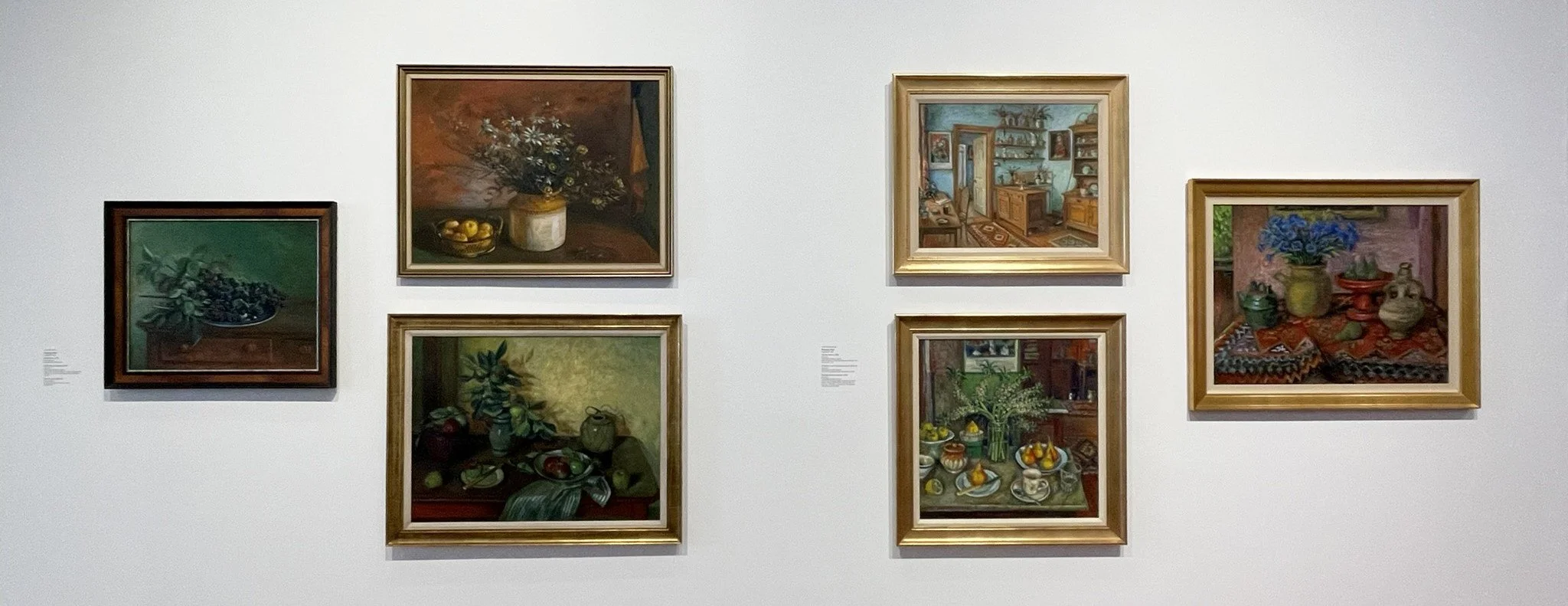
Installation view, Margaret Olley: Australian Intimiste, National Art School, 2026. Seen together, Olley’s still lifes and interiors reveal how the rooms, objects and arrangements she painted became increasingly autobiographical, collectively forming a kind of portrait of the artist and the world she inhabited.
Perhaps this is why the paintings continue to hold audiences and why, after seeing several exhibitions of Olley’s work, I still find something new in them. They ask us to do something increasingly uncommon, which is simply to slow down and look.
Olley spent a lifetime carefully observing things many of us would walk past without noticing, whether it was afternoon light moving across a wall, fruit sitting on a table, flowers beginning to open, a reflection on a ceramic pot or a doorway providing a glimpse into another room. Through sustained observation, and through a lifetime committed to the act of painting, she transformed these ordinary things into something extraordinary.
Her rooms became her subject, her possessions became her vocabulary, and painting became her voice, creating a visual language so distinctive that we recognise an Olley almost immediately.
More than a decade after her death, audiences continue to stand before those paintings, slowing down to look and, for a brief time, entering the remarkable world Margaret Olley created.
Exhibition details
Margaret Olley: Australian Intimiste
National Art School Gallery, Darlinghurst, Sydney
31 July – 25 October 2026
Free admission